
Which countries to start Apple Ads in on a small budget
Where to start Apple Ads (formerly Apple Search Ads) on $10–100/day, based on my 2026 spend and revenue by country across about ten subscription apps.
11 min readView as Markdown
Short answer
Start with one country in its own campaign: a non-English-speaking tier-1 market such as Germany, France or the Netherlands, or a tier-2 market such as Brazil or Poland. Translate the product page first. Skip the US, UK, Canada and Australia, where installs cost me more and data comes in slowly. Don't start in Japan or Korea, and leave tier-3 markets until one setup is profitable.
On this page
- What my 2026 numbers look like
- Why not start in the US?
- Which country should you test first?
- Translate the product page before you spend there
- Why I always run one country per campaign
- How many countries can a small budget handle?
- When to keep a country and when to drop it
- What about cheap tier-3 markets?
- Where Apple's defaults work against small budgets
- FAQ
Numbers come from my own Apple Ads and RevenueCat exports (January 1 to November 24, 2026), rounded, and from Apple's help pages, linked where they're used.
Apple Ads (formerly Apple Search Ads) runs in 91 App Store countries and regions. With $20 a day you can learn about one of them at a time. This article is about which one to start with, and how to tell when it's working.
I run around ten subscription apps on Apple Ads. Everything below comes from that account, and I'll show the numbers, rounded, including the ones that don't flatter my own advice. It assumes Apple Ads Advanced, where you pick keywords and bid on each one. Basic has no keyword bids, so most of the campaign advice here doesn't apply to it.
What my 2026 numbers look like
Between January 1 and November 24, 2026, I spent about $60,000 on Apple Ads across 88 countries, and RevenueCat recorded about $83,000 of revenue from Apple Ads users in the same period. That's a ROAS (revenue ÷ spend) of roughly 1.4x before Apple's commission and about 1.2x after my 15% rate.
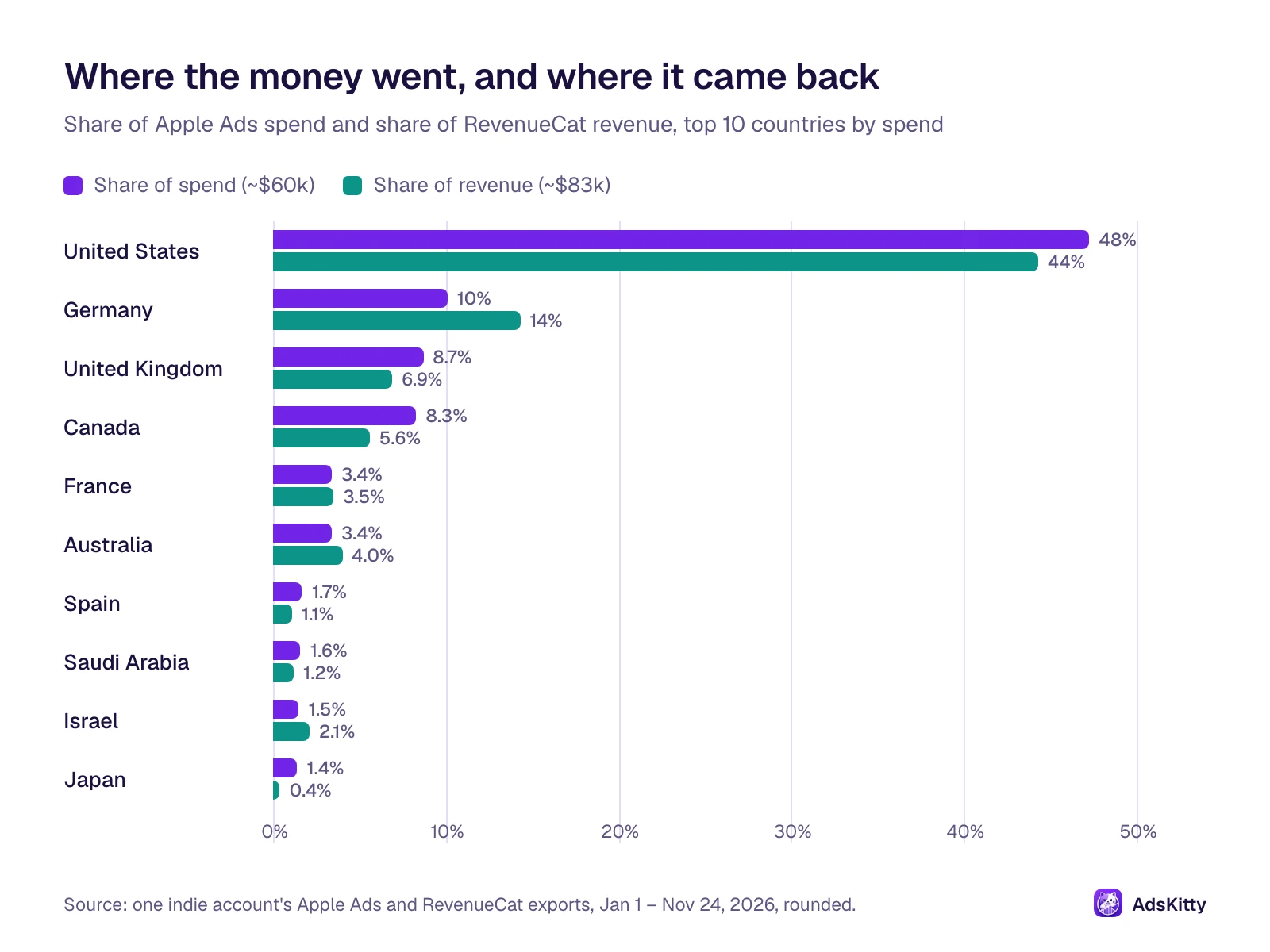
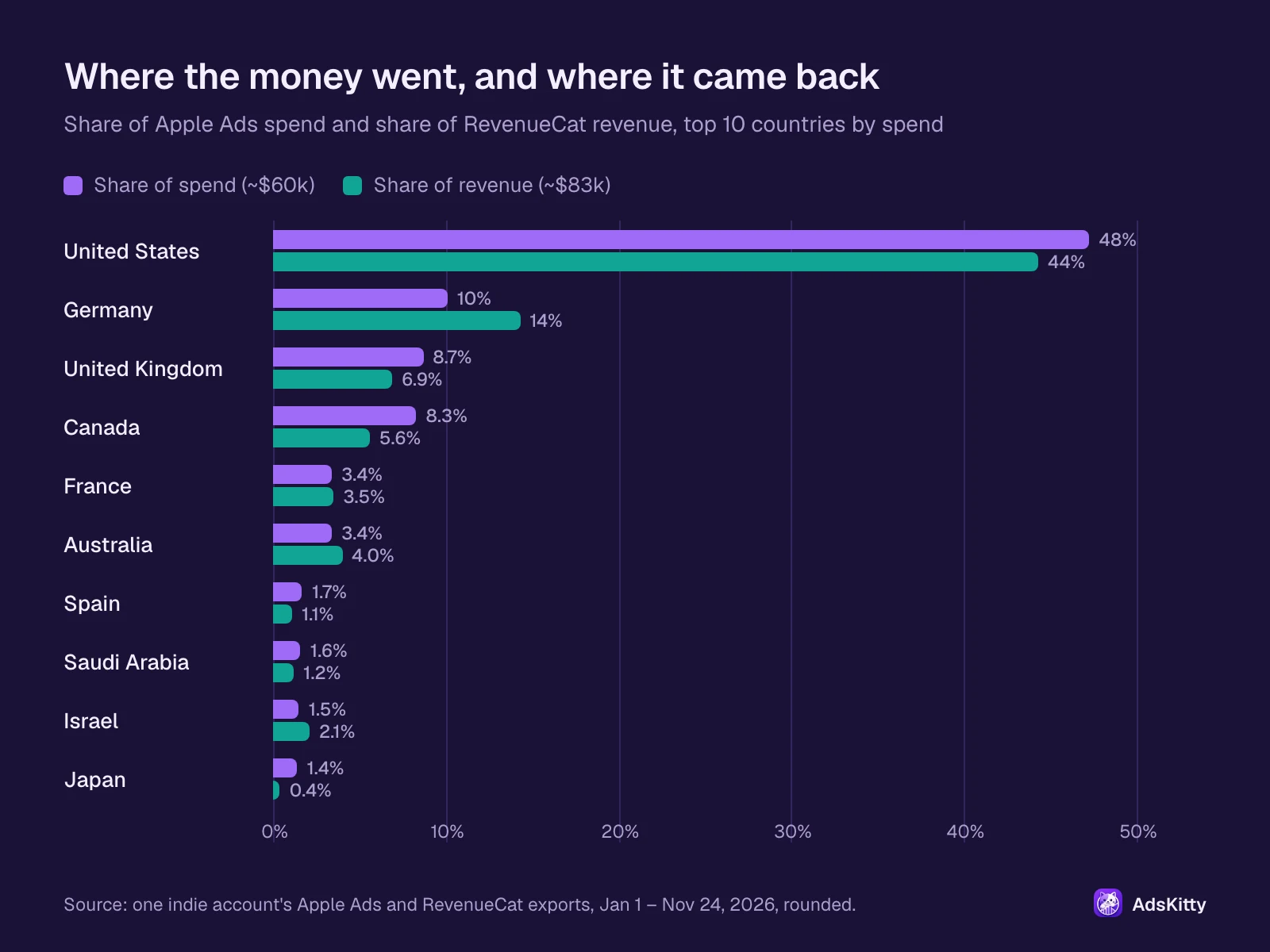
The spend is lopsided. The US alone took 48% of it, and the US, Germany, the UK and Canada together took 75%. Across the account a tap cost just under $1, about 15% of impressions became taps (TTR), about 66% of taps became installs (CR), and an install cost about $1.50.
Three caveats before you compare any of this with your own account:
- It's calendar-period revenue. It includes renewals from people who subscribed before 2026 and misses the renewals that 2026 users will pay next year. It shows money in against money out for this year. It says nothing about lifetime value.
- Revenue is net of taxes and before Apple's cut. I'm on the 15% rate, so I show both. If you're on 30%, multiply the "before" figure by 0.7.
- These aren't controlled tests. Different apps, keywords and start dates sit behind each country, so read the comparisons as one account's evidence.
Installs are tap-through installs from the Apple Ads report. The export has no app or campaign names, so every figure is per country across all my apps.
Why not start in the US?
The US is my biggest paying market and also my most expensive one, which makes it a poor place to learn on a small budget. In 2026 my US taps averaged about $1.50, against about $0.65 in Germany and $0.50 in France.
I kept the US running for a long time, because I have the budget for it and it's my best-paying country, with about 44% of my revenue. But each dollar there returned about 1.3x before Apple's cut and 1.1x after it. Germany returned about 2.0x and 1.7x.
At $10–100 a day the bigger problem is speed. A US install cost me about $2.20, so $20 a day buys roughly 9 installs, and a week of that tells you very little about who pays.
It also got harder this year. Since March 2026 Apple shows more than one ad in App Store search results on iOS and iPadOS 26.2 and later, further down the list as well as at the top. Your ad can appear in any of those positions, but "you can't select or bid for a particular one" (MacRumors, January 2026). After the new slots arrived, my bids and my spend went up a lot, and every test got more expensive.
Public benchmarks put CPTs higher than mine. MobileAction's 2025 search-results CPTs are $2.60 in the UK (the highest in their table), $1.93 in the US, $1.78 in Germany, $1.07 in France and $0.87 in Italy (MobileAction). Their US–Germany gap is much smaller than mine, and they put the UK above the US, where I have it well below. Treat any benchmark, mine included, as a rough guide to how countries compare, and expect your own dollar amounts to differ.
Which country should you test first?
Pick one market that isn't English-speaking: a rich tier-1 country such as Germany, France or the Netherlands, or a tier-2 country where people still pay, such as Brazil, Poland or Türkiye. I stay away from English-speaking markets for a first test because they have the most competition and they're expensive.
There's no official tier list. In this article, tier 1 means high-income markets with high App Store spending: the US, UK, Canada, Australia, Germany, France, the Netherlands, Belgium, Switzerland, Austria, the Nordics, Japan and Korea. Tier 2 means mid-sized or middle-income markets where people still pay, such as Spain, Italy, Poland, Türkiye, Brazil, Mexico and the Gulf states. Tier 3 means the cheapest taps: India, the Philippines, Indonesia, Vietnam, Egypt and similar.
Here's tier 1 in my 2026 export, rounded:
| Country | Spend | Avg CPT | CR (tap → install) | Cost per install | Revenue ÷ spend, before Apple's cut | After 15% cut |
|---|---|---|---|---|---|---|
| United States | ~$29k | ~$1.50 | 67% | ~$2.20 | 1.3x | 1.1x |
| Germany | ~$6k | ~$0.65 | 71% | ~$0.95 | 2.0x | 1.7x |
| United Kingdom | ~$5k | ~$1.00 | 66% | ~$1.50 | 1.1x | 0.9x |
| Canada | ~$5k | ~$1.20 | 62% | ~$1.90 | 0.9x | 0.8x |
| France | ~$2k | ~$0.50 | 67% | ~$0.75 | 1.4x | 1.2x |
| Australia | ~$2k | ~$1.15 | 61% | ~$1.90 | 1.6x | 1.4x |
| Japan | ~$800 | ~$1.10 | 39% | ~$2.85 | 0.4x | 0.35x |
| Netherlands | ~$600 | ~$0.70 | 72% | ~$1.00 | 2.4x | 2.0x |
| Korea | ~$500 | ~$0.55 | 34% | ~$1.70 | 0.2x | 0.15x |
| Belgium | ~$500 | ~$0.60 | 68% | ~$0.85 | 2.4x | 2.1x |
| Norway | ~$300 | ~$0.75 | 53% | ~$1.45 | 1.5x | 1.3x |
Austria and Switzerland look spectacular on paper (over 5x), but on under $200 of spend each there's too little to read anything into.
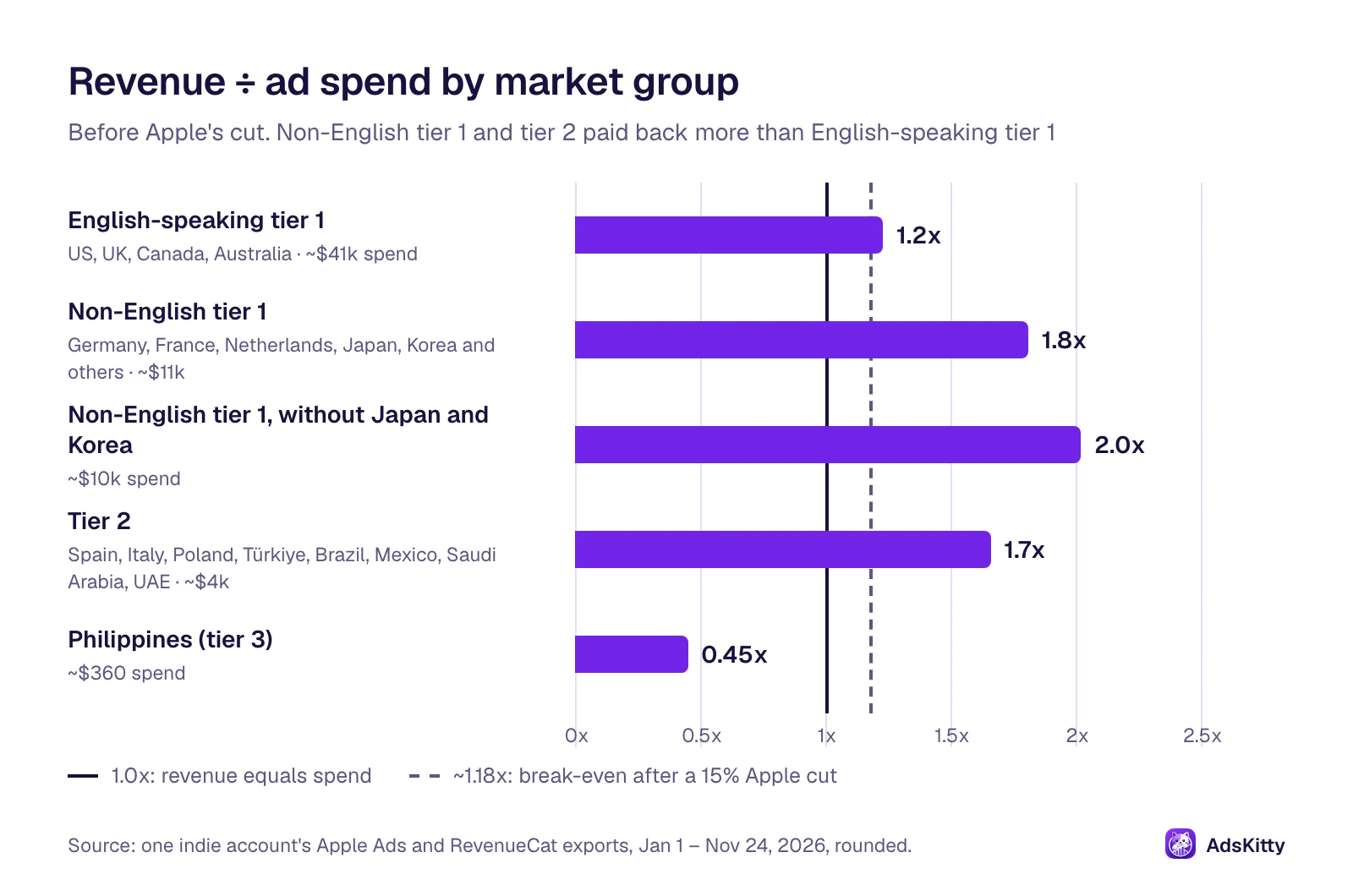
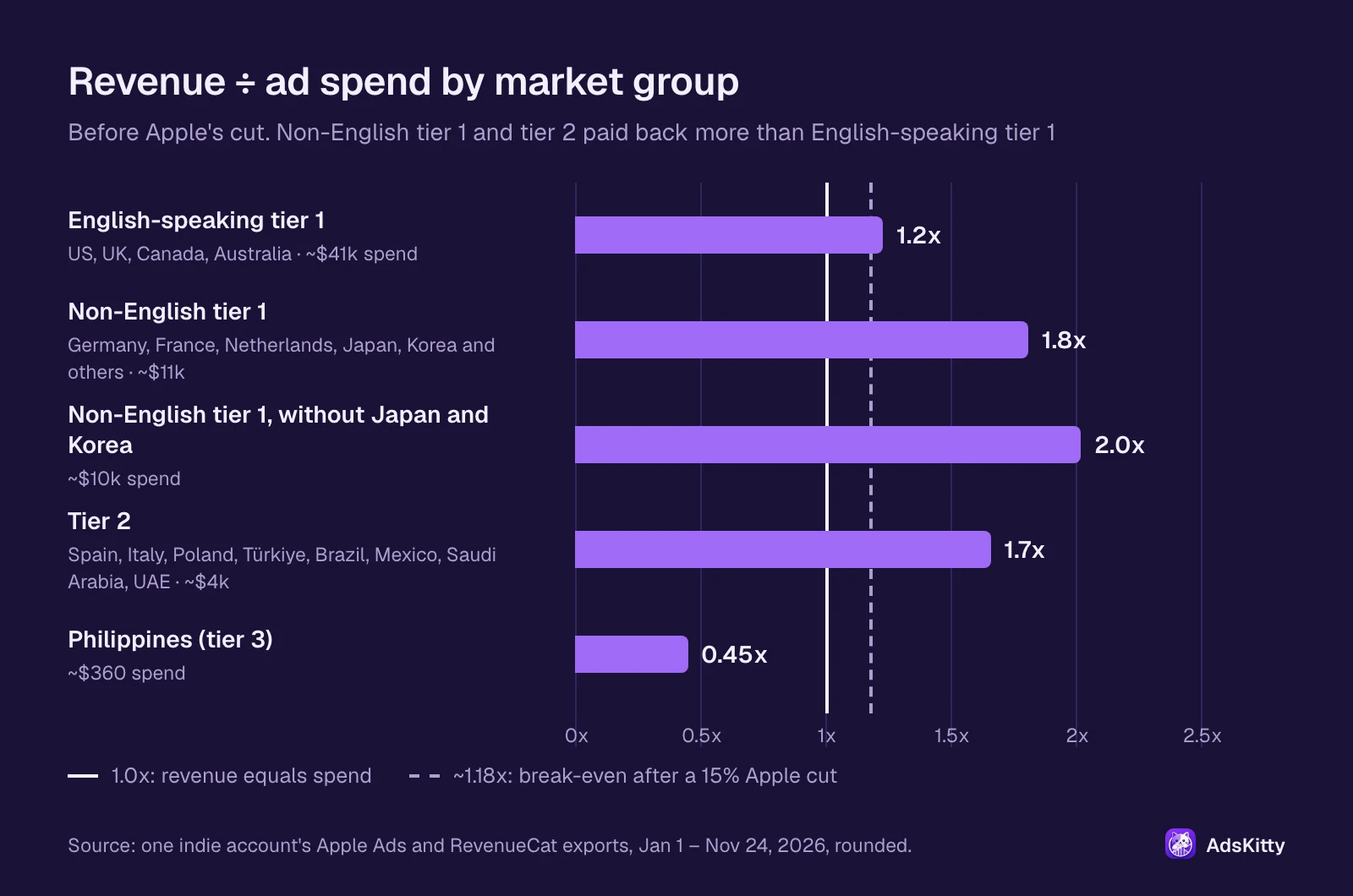
As a group, my English-speaking tier-1 markets returned about 1.2x before Apple's cut, roughly break-even after it. Most of that spend is the US (about $29k of about $41k), but the other three did no better: the UK, Canada and Australia together returned about 1.1x on about $12k. The non-English tier-1 markets returned about 1.8x, or about 1.5x after the cut, on roughly a quarter of the spend.
Australia on its own did well: about 1.6x on about $2,000, ahead of France. I'd still skip it as a first market. At about $1.90 per install, 100 installs take about 9 days at $20 a day, against about 4 in France. That's a speed reason, not a return reason.
Germany is the non-English market with by far the most spend, and it held up on about $6,000. Japan and Korea went the other way. Both are tier 1, neither is English-speaking, and I have Japanese and Korean localizations. Still, their CRs were far below the account's 66%, and both returned well under half their spend. Don't start in either. Leave them out and the rest of my non-English tier-1 group returned about 2.0x before Apple's cut.
Tier 2 is a reasonable first market too. As a group, my tier-2 countries (Spain, Italy, Poland, Türkiye, Brazil, Mexico, Saudi Arabia, the UAE) returned about 1.7x before Apple's cut, close to non-English tier 1. My best examples are Brazil, Poland and Türkiye: about 3.0x, 2.8x and 2.1x, on a few hundred dollars each. There's a catch. All three ran with localized product pages, for apps and keywords that were already profitable in other countries. They show what tier 2 can do with a setup that already works. They can't tell you how a brand-new app does there as its very first market.
Start with one country from this shortlist. Add the next only when the first is clearly profitable or has clearly failed: conversion to paying clearly above break-even, or still clearly below it after you've worked on the paywall and onboarding (the rules are further down). Until then, a second country halves the data you collect on the first.
Adapty's advice for Apple Ads Basic is to "start with three to five [countries] where your app already performs organically" (Adapty). Basic has no keyword bids, but the idea of starting where you already earn carries over, with one condition: the country has to be non-English tier 1 or tier 2. If your organic revenue is mostly American, that tells you where the money is, not where a small budget can learn. To see where you already earn, check Proceeds by Territory in App Store Connect's Analytics (Apple: Sales in Analytics), or segment RevenueCat's revenue chart by country, which since Charts v3 prefers the App Store storefront over IP location (RevenueCat).
Translate the product page before you spend there
Localize the App Store product page before you advertise in a non-English country, and leave the app for later. The product page is what the ad shows and what people read before they install, and Apple says your "app title, descriptions, and keywords are all used to assess your app's relevance for specific search queries" (Apple Ads: tips for performance issues). An English-only page bidding on German search terms starts with a handicap. In some countries translation is a requirement: Apple says your metadata and screenshots must be in the storefront's default language before you can advertise there, and names Brazil as an example (Apple Ads: create campaigns).
Translating the name, subtitle, description, keywords field and screenshot captions is a small job next to translating the whole app and paywall. Do the small job first, see whether the country pays, and translate the app once it has earned that work.
One warning about my own numbers. In the countries where I localized, I translated the app and the paywall as well as the product page. So Germany's 2.0x comes from a fully localized app, and page-first is the order I'd do the work in, not something these numbers test. Don't read my German result as what a translated product page alone will get you.
Why I always run one country per campaign
Put each country in its own campaign, even at $10 a day. A keyword in an ad group has one max CPT bid, and that bid applies in every country the campaign targets. In a Germany + Austria + Switzerland campaign, you can't bid $0.60 on a term in Germany and $1.20 on the same term in Switzerland.
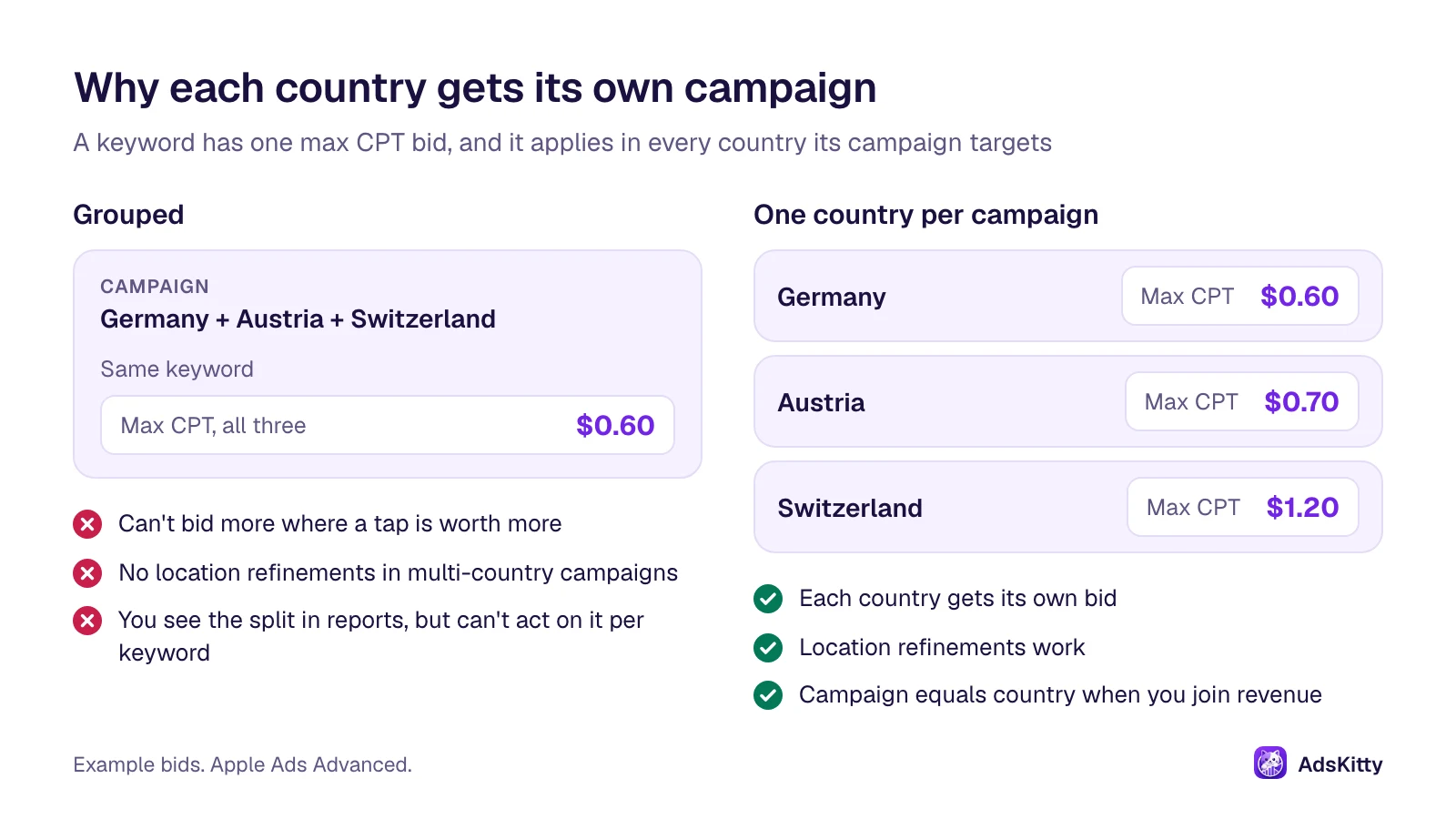
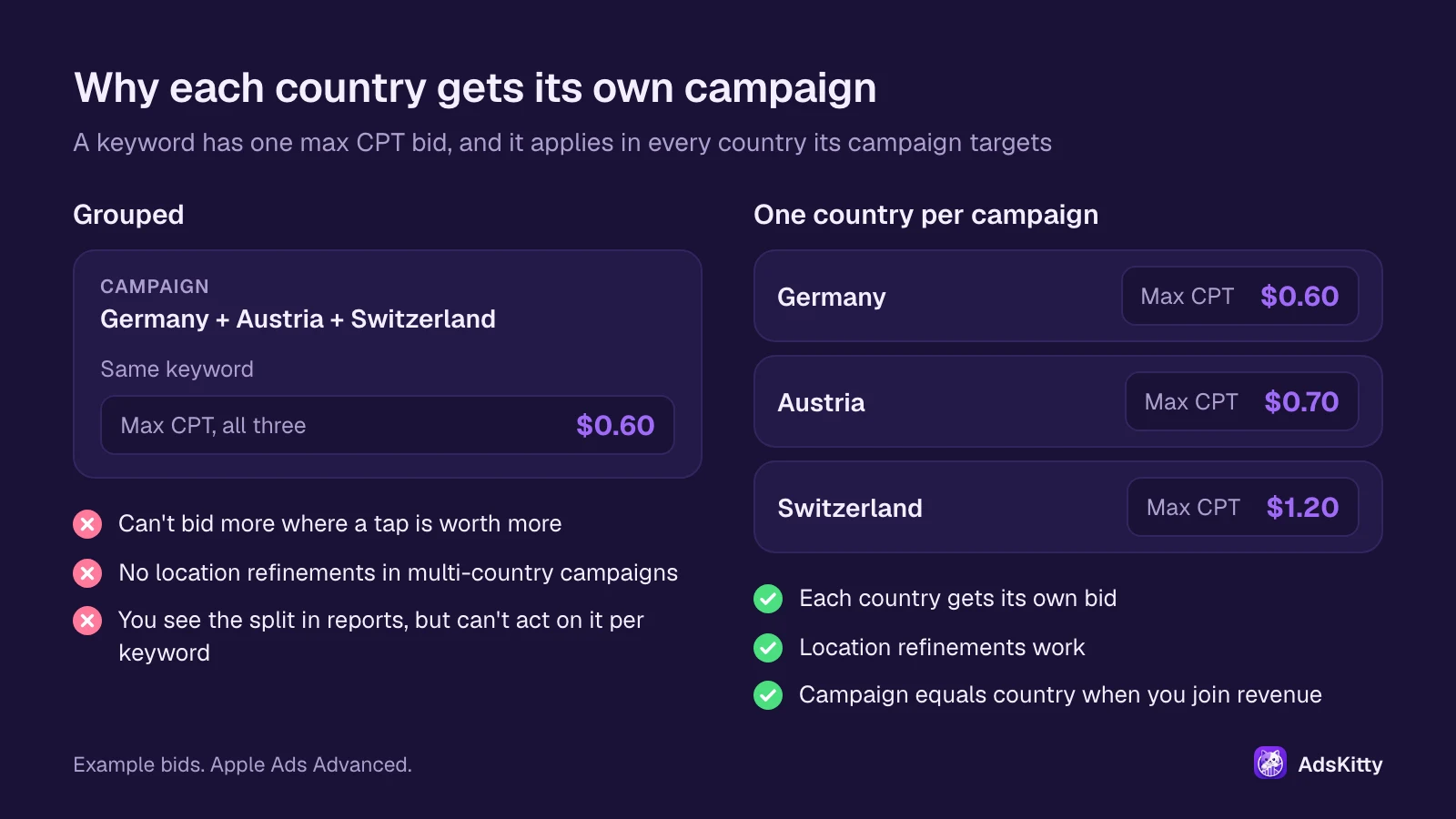
Apple's own help goes the other way. When you pick countries, it suggests you "consider grouping similar countries and regions in one campaign for easier management" (create campaigns), and the campaign-structure guide calls grouping a fit when "customer value [is] the same across more than one country or region" (structure campaigns). On a small budget you don't know that yet. Finding it out is the whole point of the test.
Grouping also costs you features. Location refinements, such as limiting a campaign to one region of a country, "can't be set within campaigns that are running in multiple countries and regions" (Apple Ads: audience settings). The reports still split spend and installs by country, but you can't act on what they show at keyword level.
How many countries can a small budget handle?
Fewer than you'd like. Spread a small budget over many countries and none of them collects enough data for a decision.
My own export shows it. Of the 88 countries with spend in 2026, 62 got less than $100 each over almost eleven months. Most of that long tail comes from my early campaigns, which covered many countries at once and spread the spend thin. Together those 62 were only about 3% of spend, so the money wasn't the problem. The problem is that I can't say anything about any of them. 38 of them don't even get their own row in RevenueCat: together they cost about $640 and brought in at most about $340, which RevenueCat lumps into "Other".
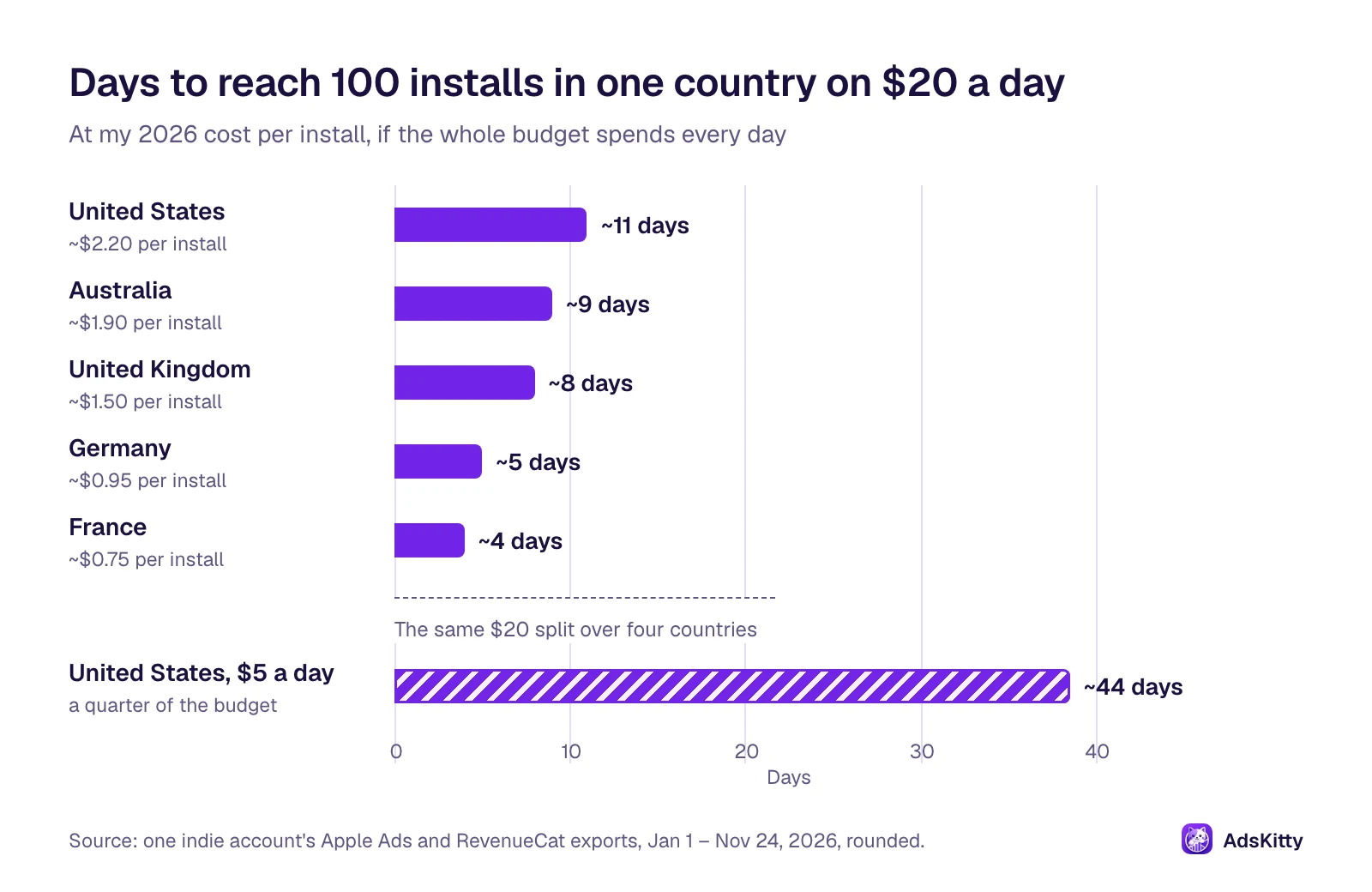
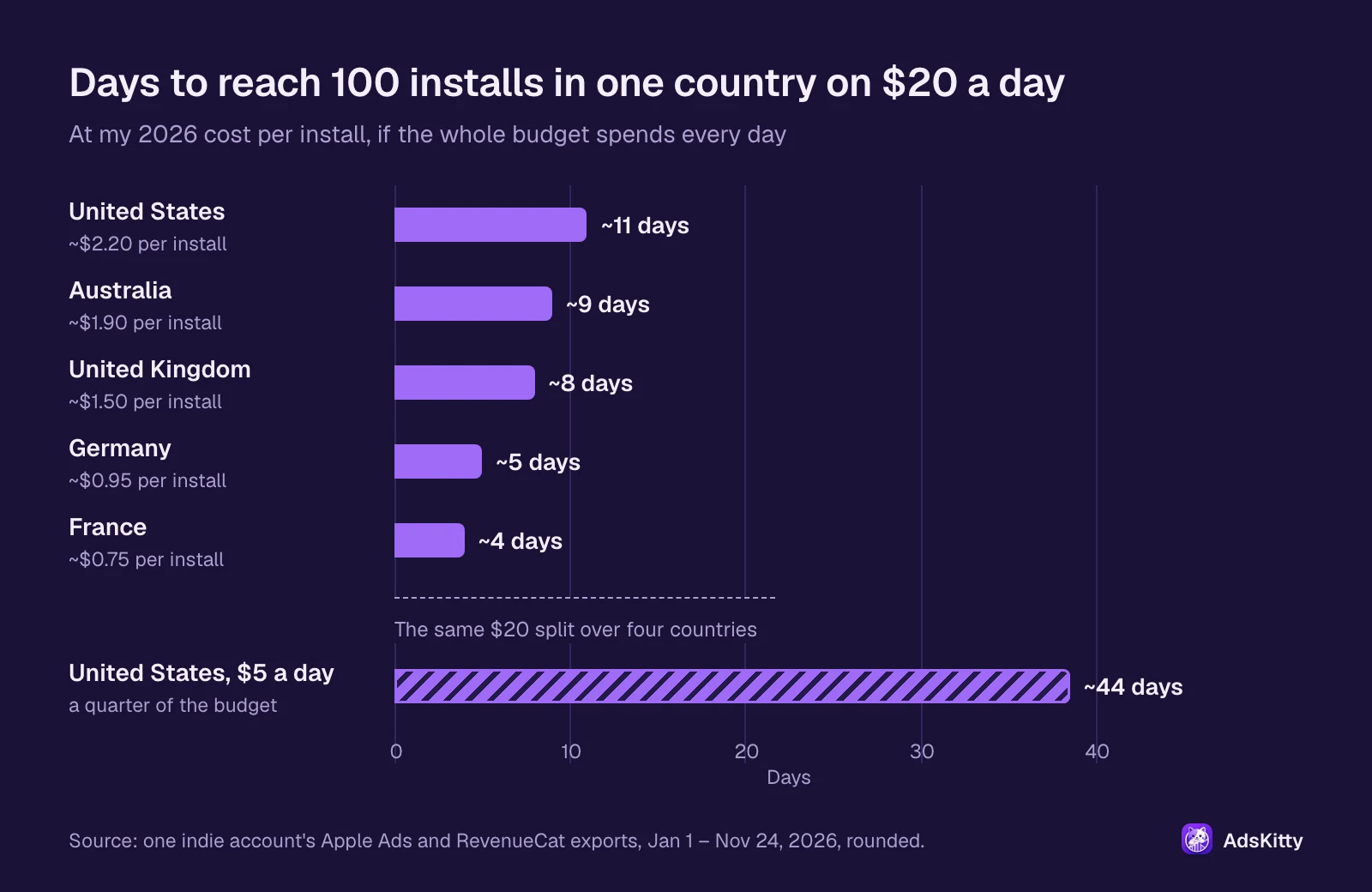
Here's how many days it takes to reach 100 installs in one country at my 2026 install costs, if the budget spends in full every day:
| Daily budget | US (~$2.20 per install) | Australia (~$1.90) | UK (~$1.50) | Germany (~$0.95) | France (~$0.75) |
|---|---|---|---|---|---|
| $10 | ~22 days | ~19 days | ~15 days | ~9 days | ~8 days |
| $20 | ~11 days | ~9 days | ~8 days | ~5 days | ~4 days |
| $50 | ~4 days | ~4 days | ~3 days | ~2 days | ~2 days |
Now split $20 a day over four countries and the US gets $5 of it: about 44 days to 100 installs, before any trial has even ended. That's why I start with one country.
When to keep a country and when to drop it
Only conversion to paying (paying customers ÷ installs) decides whether a country stays: drop it when that rate is still clearly below break-even after you've worked on the paywall and onboarding. TTR (taps ÷ impressions) and CR (installs ÷ taps) arrive first. A clear fail on either is a warning: check your keywords, ad and product page. It doesn't drop the country by itself.
Wait for at least 300 impressions before reading TTR, 100 taps before reading CR and 100 installs before reading conversion to paying. Conversion to paying also takes the longest to show up. RevenueCat's Apple Ads attribution usually lands within about 24 hours of a new customer and can take up to 7 days for a new campaign (AdsKitty: Apple Ads attribution in RevenueCat), and then any free trial has to run out before you know who pays. Count that time into every test.
Reading the Wilson interval
A Wilson score interval is a range that probably contains the true rate, given how many tries you've seen. It behaves well on small samples and on rates near 0%, which is where indie Apple Ads data lives. At the minimums it looks like this:
| What you're reading | Sample | Observed | Wilson 95% range |
|---|---|---|---|
| TTR | 300 impressions, 45 taps | 15% | ~11% to ~19% |
| CR | 100 taps, 65 installs | 65% | ~55% to ~74% |
| Conversion to paying | 100 installs, 5 paying | 5% | ~2% to ~11% |
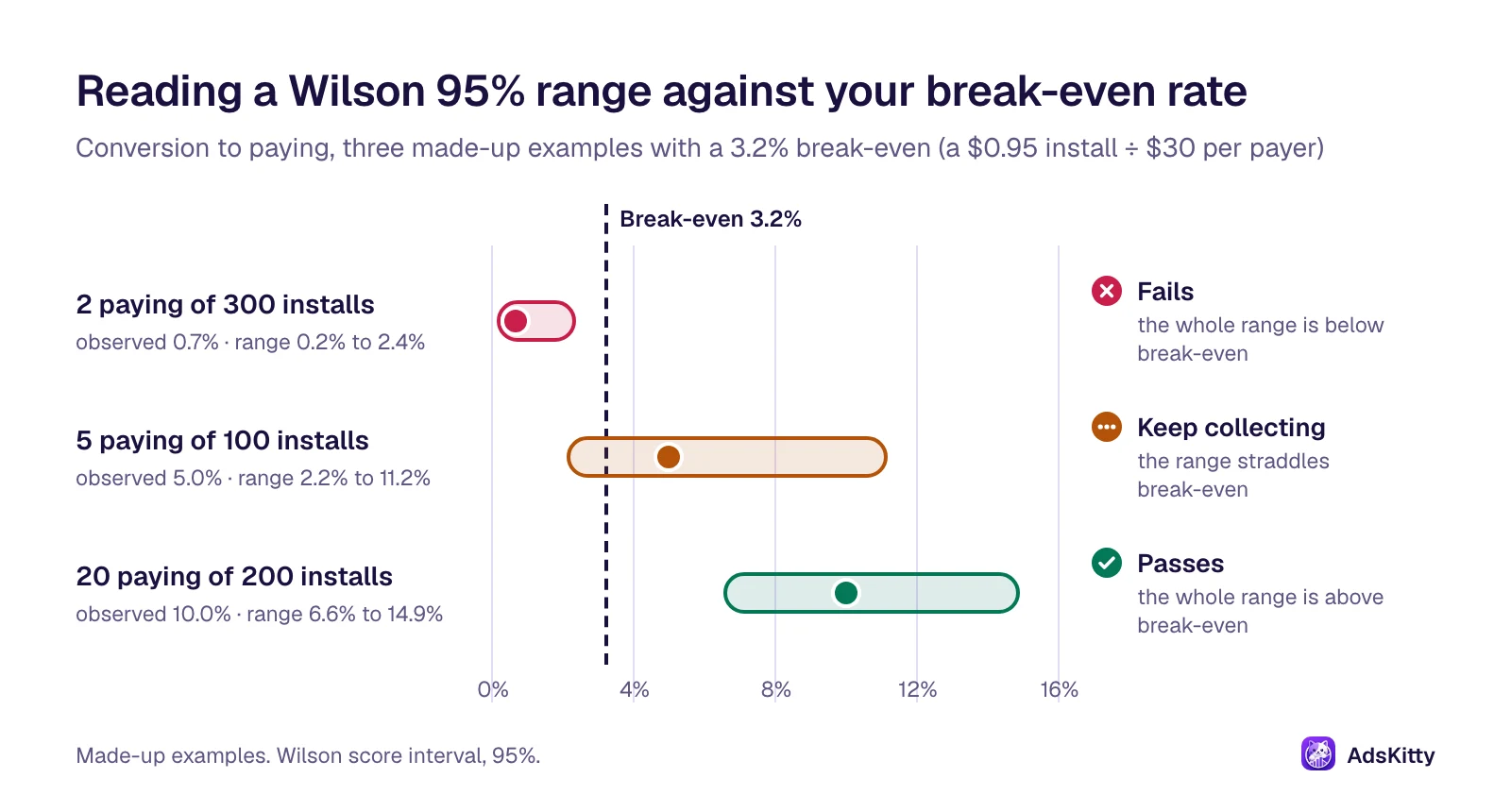
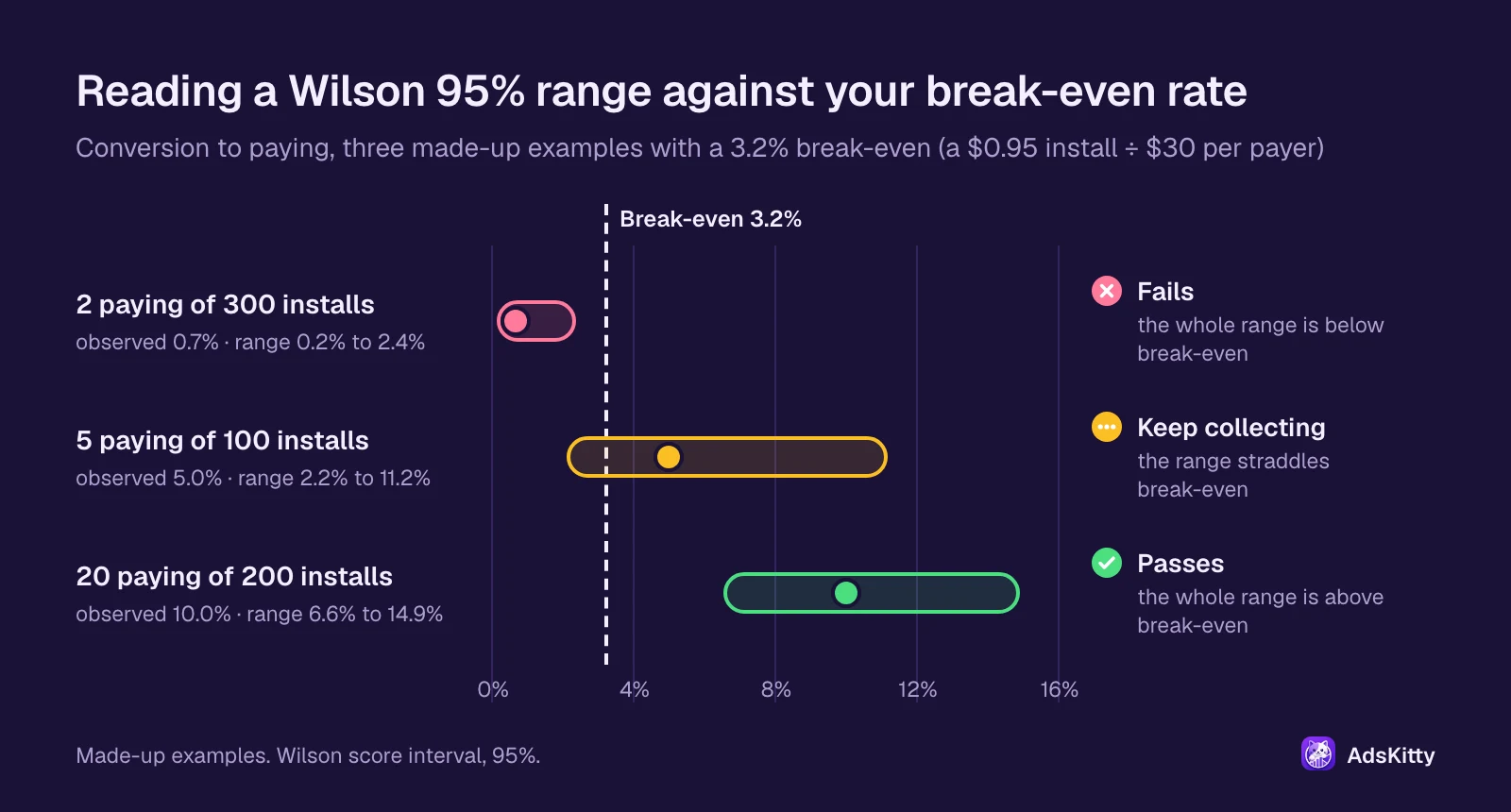
Compare the range with your target for that number:
- The whole range is below the target: that number fails.
- The whole range is above the target: that number passes.
- The range straddles the target: keep collecting.
For conversion to paying, the target is your break-even rate: cost per install divided by what a paying customer brings you after Apple's cut. You won't know lifetime value while you test, so use what your existing payers brought in during their first year, or only the first payment if you want to be conservative. As a made-up example, a $0.95 install cost and $30 per paying customer give a break-even of about 3.2%. The 5-in-100 row above (about 2% to 11%) straddles it, so you'd keep collecting.
For TTR and CR, set targets from your own account, and expect them to change by app and by country.
If you'd rather compute the interval than use an online calculator:
func wilson(_ successes: Double, _ trials: Double, z: Double = 1.96) -> (low: Double, high: Double) {
    let p = successes / trials, z2 = z * z
    let center = (p + z2 / (2 * trials)) / (1 + z2 / trials)
    let half = z / (1 + z2 / trials) * (p * (1 - p) / trials + z2 / (4 * trials * trials)).squareRoot()
    return (center - half, center + half)
}
What to do with each result
- TTR or CR clearly below your target: investigate. TTR happens before the tap, so look at your keywords and the ad. CR happens after it, so look at the product page. Neither drops the country on its own.
- Conversion to paying straddles break-even: keep collecting.
- Conversion to paying clearly above break-even: keep the country, and add the next one from the shortlist.
- Conversion to paying clearly below break-even: keep the campaign for now and fix the paywall and onboarding. If it's still clearly below break-even after that, drop the country. Don't add a new country in the meantime.
To measure a fix, count only installs that came after the change, wait again for 100 installs plus the length of the trial, and change one thing at a time. Installs from before the change measure the old paywall.
Fixing monetization doesn't always work. I had a country with a 35% TTR and an 80% CR, both far above my account averages of about 15% and 66%, and it barely sold, even after I changed the monetization. Sometimes the audience is the problem: they just might not pay.
It works the other way too. Poland's TTR (about 11%) and Türkiye's (about 9%) were well below my 15% average, on thousands of impressions each, and both countries returned more than 2x. A TTR or CR below your account average tells you something to fix. It tells you little about whether the country will pay.
Japan and Korea show what a CR warning looks like when the money agrees. Japan's CR was 39% on about 720 taps, a Wilson range of about 36% to 43%. Korea's was 34% on about 930 taps, about 31% to 37%. Against a CR target in the mid-40s, both are clear fails, and their revenue (0.4x and 0.2x) said the same. Israel is the counterexample: a CR of 42% on about 940 taps, not far above Japan's, and it returned 1.9x.
The same logic is why I agree with ranking countries by cost per paying subscriber, not by CPT (Adapty's 2026 country report does exactly that). A $0.30 tap that never pays costs more than a $1.50 tap that does.
The Apple Ads console stops at the install, so conversion to paying per country has to come from somewhere else. You can join RevenueCat's attributed revenue with the Apple Ads report by campaign in a spreadsheet; with one country per campaign, campaign equals country. Without RevenueCat, App Store Connect's Sales pages give you a free, rough check: Proceeds by Territory, and Download to Paid Conversions at 1, 7, 14, 35 and 40 days after download (Apple). Apple doesn't document a split of those by Apple Ads campaign, so organic and paid users sit in the same numbers. AdsKitty does the RevenueCat join for you: it shows revenue, ROAS and conversion to paying per campaign and keyword, next to spend.
What about cheap tier-3 markets?
Don't go to tier-3 markets until you've found a setup that's profitable somewhere else. I disagree with the common "test cheap markets first, then scale" advice. Test in non-English tier 1 or in tier 2.
The cheapest taps also leak the most. Adapty's 2026 report, built on 2025 data, gives Algeria and Nepal some of the lowest CPTs (around $0.11) but only 10 and 3 paying subscribers per $1,000 of spend, with Nepal at $362.55 per paying subscriber (Adapty). Its sample only includes apps spending at least $10,000 a year on Apple Ads (PPC Land summary), which most readers of this article aren't, so take it as context for your own account. On their numbers the US gives 15 paying subscribers per $1,000, fewer than many cheaper markets.
My own numbers outside tier 1, for countries with more than $150 of spend in 2026:
| Country | Spend | Avg CPT | Revenue ÷ spend, before Apple's cut |
|---|---|---|---|
| Spain | ~$1,000 | ~$0.70 | 0.9x |
| Saudi Arabia | ~$950 | ~$0.55 | 1.0x |
| Israel | ~$900 | ~$0.95 | 1.9x |
| Italy | ~$500 | ~$0.40 | 2.2x |
| Mexico | ~$470 | ~$0.80 | 1.6x |
| Brazil | ~$430 | ~$0.55 | 3.0x |
| Philippines | ~$360 | ~$0.45 | 0.45x |
| Malaysia | ~$290 | ~$0.50 | 0.6x |
| UAE | ~$280 | ~$0.60 | 2.4x |
| Poland | ~$210 | ~$0.50 | 2.8x |
| Türkiye | ~$200 | ~$0.30 | 2.1x |
| Thailand | ~$170 | ~$0.40 | 1.1x |
The Philippines, the one true tier-3 market I spent real money in, returned under half its spend, and Malaysia about 0.6x. Tier 2 isn't a sure thing either: Spain and Saudi Arabia barely covered their spend before Apple's cut, while Brazil, Poland and Italy did well on a few hundred dollars each.
Where Apple's defaults work against small budgets
Two of Apple's suggestions make sense for big advertisers and hurt you at $20 a day.
- "Run everywhere." Apple's fix for low impressions is "running your ad in every App Store country and region where your app is available" (Apple). That's up to 91 storefronts. It helps if too few impressions is your problem. At $20 a day your problem is too little data per country, and this makes it worse: on a small budget it's the fastest way to learn nothing.
- Maximize Conversions. Launched in February 2026, it pairs Search Match with an auto-bidder against a target CPA. Apple creates an automated ad group that you can't remove, where you can't turn Search Match off, and "you can't add or manage keyword bids in Maximize Conversions campaigns" (Apple Ads help). I don't recommend it. I couldn't pause the automated ad group or manage it, and I tried Maximize a few times without a single success.
FAQ
How many countries can I run Apple Ads in?
As of November 2026, Apple lists 91 App Store countries and regions where ads can run, and 129 countries and regions where advertisers can be based (Apple). The November 12, 2026 news about Albania, Algeria, Iceland, Iraq, Morocco and South Africa (Apple Ads news) means advertisers based there can now sign up. Ads already ran in all six, so they aren't new markets to rush into.
Should I run one Apple Ads campaign per country or group countries?
One per country. A keyword's max CPT bid is shared by every country in a campaign, and location refinements don't work in multi-country campaigns. Apple suggests grouping when customer value is the same across countries, but on a small budget you don't know that until you've tested each one.
Is the US worth it for Apple Ads on a small budget?
Usually not as a first market. US taps cost me more than twice what German ones did in 2026, and each dollar returned less. With $10–100 a day you collect data too slowly there to make decisions.
Do I need to localize my app before advertising in a country?
Localize the product page first: name, subtitle, description, keywords and screenshots. Apple uses that metadata to judge relevance, and some countries, Brazil among them, require it in the local language before you can advertise. Translate the app and paywall once the country pays. My own numbers come from countries where the app was localized too, so they don't show what a translated page alone does.
How long should I test a country before dropping it?
Wait for at least 100 installs, plus up to 7 days for attribution and the length of any free trial, then compare conversion to paying with your break-even rate using a Wilson 95% range. If the whole range is below break-even, fix the paywall and onboarding, measure again on new installs only, and drop the country if it's still clearly below. TTR (after 300 impressions) and CR (after 100 taps) come in sooner; a clear fail on either is a warning to check keywords, the ad and the product page, and doesn't drop the country by itself.
Which country has the cheapest Apple Ads CPT?
Markets such as Algeria and Nepal have some of the lowest CPTs, around $0.11 in Adapty's 2025 data. They also convert to paying very poorly, so they're cheap per tap and expensive per paying subscriber. Rank countries by what a paying subscriber costs you.